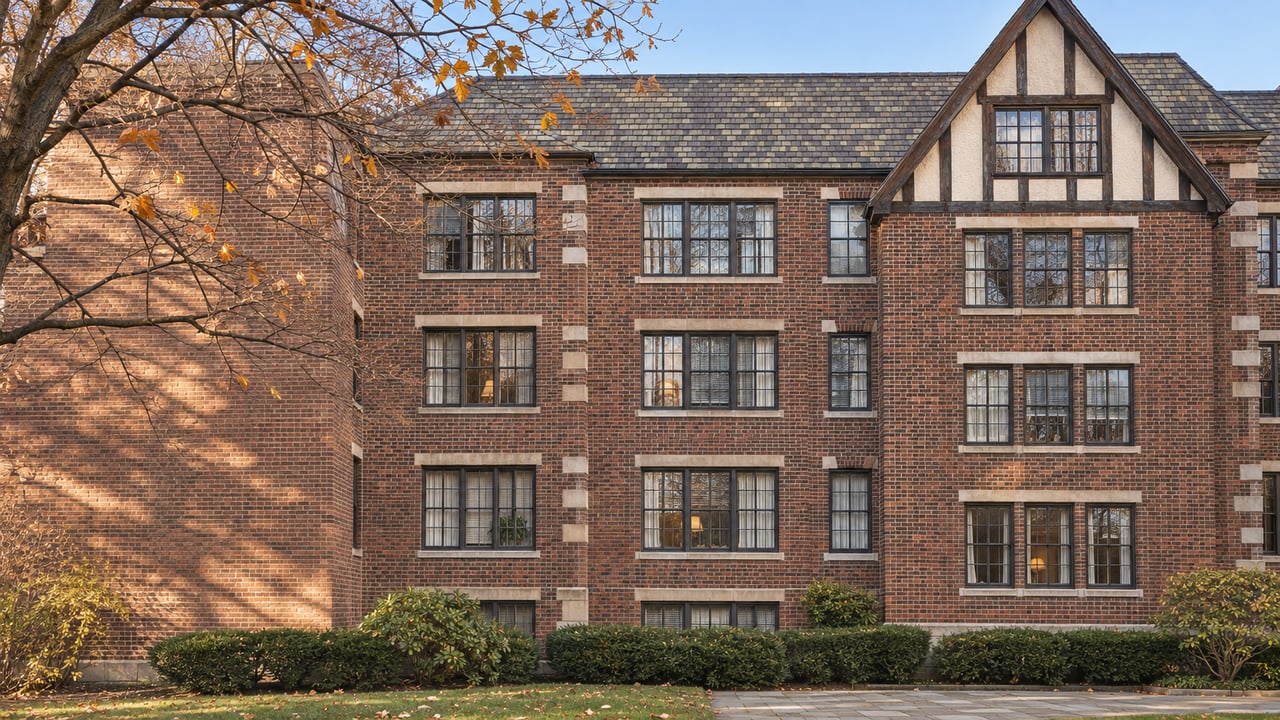
Every apartment on Garth Road is a short walk from the Scarsdale train station. That walk is roughly the same from every building, so it can't tell one Garth Road co-op from another. The year the building went up can. The street is a half-mile of 13 mid-rise buildings built between 1926 and 1966, and each wave of construction followed its own rules on unit size, parking and design. Westchester's co-op market is moving slower than its single-family market this fall. That leaves a buyer time to find out what a building's era means for the apartment they are about to make an offer on.
Garth Road sits in unincorporated Eastchester, not in the Village of Scarsdale. Its northern end opens onto a small commercial strip, with the Scarsdale Metro-North station just past it. That station is the second busiest on the Harlem Line. The Bronx River Reservation runs along the west side of the enclave. Grayrock Road runs along the tracks on the east side and gives access to parking and to the garages behind the east-side buildings. At the south end is Garth Park, a 1.62-acre town park with a ballfield and playground. The whole district has just two ways in, one at each end.
Robert L. Mawson's December 2025 history, The Development of Garth Road, Eastchester, New York, 1926-66, catalogs every building by address. Read with the market in mind, it sorts the street into three generations of housing.
The Late-1920s Tudor Row Was Built for Families, and Without Parking
The first seven buildings went up between 1926 and 1929 along the west side of what was then Belmoy Road. They are Scarswold at 155, Thornycroft at 209, Eton Hall at 127, Cragswold at 187, Northgate at 105, Eton Lodge at 117 and Colchester Hall at 143. The master developers, Mooney & Beatty, wrote rules into their land sales. Buildings had to be four to six stories, residential only, set back the same distance from the street and separated by green buffers. That is why the row still looks like a single composition.
Mooney & Beatty also kept parking out of the buildings at first. To make up for it, they sold the parcel at the southeast corner of Belmoy and Grayrock Roads for a separate garage. The Grayrock Garage opened the next year with four stories and 176 spaces. For a buyer today, the 1920s building with the casement windows and the slate-roof Tudor look is the one most likely to leave the car question for you to solve.
That first generation also had the largest apartments. Mawson compares Scarswold, the first building on the street, with Scarsdale Manor across the road. Scarswold was smaller, more carefully detailed and had only family-size units. Scarswold is also the row's exception today. It was built as a co-op, stopped being one by 1939, and an LLC now owns it as a rental. It still has its original steel casement windows. Cragswold went the other way and has stayed a cooperative for its entire history.
Scarsdale Manor Marks the Turn to Smaller Units and Built-In Garages
Construction stalled through the Depression. It restarted after the National Housing Act of 1934 put federal guarantees behind multifamily financing, and that money pushed designs toward larger, denser and plainer buildings. Scarsdale Manor at 178-88 Garth Road opened in 1938. It was the first building on the east side of the street, two six-floor buildings with 304 apartments, mostly studios and one-bedrooms, and a 228-space garage reached from Grayrock Road.
So the street's first big jump in density came with parking built in, and the smaller unit sizes came with it. If you are a buyer who needs a one-bedroom and a parking space, the late-1930s building and the 1920s row answer that need very differently, even though they face each other across the same street.
The Postwar Complexes Put the Parking Underneath
The last generation is the largest. Garth Woods at 235 Garth Road was the first postwar project to get built, in 1948, with 258 units in six structures set on top of a parking structure. Essex Place, the Garth Essex complex at 230-280 Garth Road, finished the street in 1966 with 347 units across several buildings, also with parking built in. The postwar era added just under 1,000 units in all, 20 percent more than everything built before World War II.
Most of the street's apartments are in this last generation. These buildings went up last, so they are also the youngest on the street. Garth Woods became a cooperative in 1984 as Garth Woods Owners.
Every Building Went Co-op at a Different Time
All 13 buildings started out as rentals except Scarswold and Cragswold. Conversions to cooperative ownership began in the 1970s and came building by building. Eton Hall converted in the late 1970s. Colchester Hall became a co-op in 1980 under Colchester Owners. The Kenilworth finished its conversion in 1981, and Garth Woods followed in 1984. Today the street is mostly owner-occupied. Only two buildings, with 80 units between them, remain rentals.
Each building converted on its own schedule and under its own ownership entity, such as Colchester Owners or Garth Woods Owners. When you buy a Garth Road co-op, you are buying a share of one specific building and its history.
The 1920s row will reach its centennial over the next few years, and the postwar complexes are now 60 to more than 75 years old. Mawson notes that Scarswold has had no significant alterations since construction apart from unit modernization. On a street this old, fire escapes, original windows, masonry and garages are real projects with real price tags. Ask any Garth Road building, whatever its era, what work has been done recently, what is planned and how it is being paid for.
The Co-op Market Gives Buyers Time to Ask
Across Westchester, co-ops are moving at a different speed from houses. In October 2026, according to OneKey MLS, county co-ops sold in a median 56 days at 98.4% of original list price, and inventory rose 9% from a year earlier to 510 units. In that same month, single-family homes sold in 42 days at 102.1% of original list. For the third quarter of 2026, OneKey put the county co-op median at $250,000 with 3.7 months of supply. Howard Hanna Rand Realty's third-quarter 2026 update shows the other side. Westchester single-family homes sold in a median 17 days at 107% of list price, with only 1.7 months of inventory.
Those county figures cover the Scarsdale station's commute in two very different ways. A house near the station sells in a market of bidding wars and short decision windows. A Garth Road co-op shares the same platform but sits in the slower co-op market, where county sales close slightly below list and buyers have weeks rather than days. Those weeks are the time to read the building's financial statements, ask about the garage and check its project history before you write a number.
The Car Question Is Still a Building-by-Building Question
The 1920s decision to keep parking out of the buildings still affects daily life on the street. The Town of Eastchester's parking applications page lists a Grayrock commuter lot, a Grayrock lot option for Garth Road residents, a Scarsdale commuter resident permit and resident street permits. It sets municipal lot spaces at $65 per spot per month, effective January 1, 2025. The Village of Scarsdale's 2025-2026 nonresident permits sold out and moved to a waitlist. Fees and availability change from season to season, so confirm current terms with the Town before you count on a space. These figures are general information, not financial or legal advice. Confirm your own situation with the right professional.
Frequently Asked Questions
Is Garth Road in Scarsdale? No. Garth Road is in unincorporated Eastchester. Scarsdale station is just north of the street, in neighboring Scarsdale. Our Eastchester school district guide covers why a mailing address and the jurisdiction can differ in this town.
Are all the Garth Road buildings co-ops? Most are. Two buildings with 80 units between them remain rentals, including Scarswold at 155 Garth Road.
Which buildings have parking built in? Scarsdale Manor, which opened in 1938, has a 228-space garage off Grayrock Road. The postwar complexes, Garth Woods and Essex Place, were built with parking. The original late-1920s row was designed without parking and relied on the separate Grayrock Garage.
If you are weighing a co-op near Scarsdale station, or thinking about selling one, Gino Bello Homes can walk you through what this market says about your building. Request a free home valuation & market consultation.